Gutscheinbedingungen

**Gültig nur für Bestellungen an die Wunsch-Poststation bis 10.06.2026 auf Spielzeug, Schreibwaren, Filme, Geschenke & Trends, Musik, tolino eReader & Zubehör, Hörbücher und Hörbuch-Downloads (außer Abo), nicht preisgebundene Bücher und Kalender online auf thalia.at und in der Thalia App. Einzelne Artikel können ausgeschlossen sein. Aufgrund der Buchpreisbindung sind deutschsprachige Bücher und eBooks ausgenommen. Zusätzlich ausgenommen sind preisgebundene Artikel, Abos & Flatrates, eBooks, Games, Geschenkkarten/-boxen, Shelfies, Software, Zeitschriften sowie einzelne Artikel von tonies®. Pro Einkauf einmal einlösbar. Kein Click & Collect möglich. Keine Barauszahlung. Nicht kombinierbar mit anderen Aktionen und Gutscheinen. Gutschein wird auf max. 500€ Bestellwert angerechnet. Nicht gültig für Versandkosten und Services.

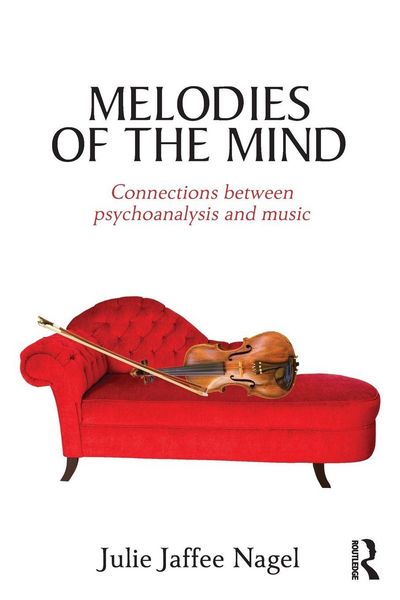
  • Produktbild: Melodies of the Mind
  • Produktbild: Melodies of the Mind

Melodies of the Mind Connections between psychoanalysis and music

47,99 €

inkl. gesetzl. MwSt., Versandkostenfrei


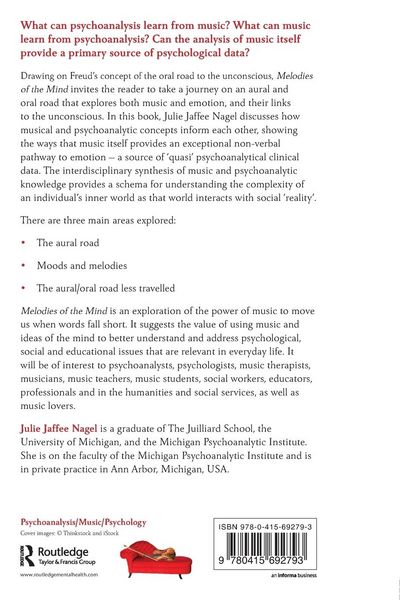
Beschreibung

Produktdetails

Einband

Taschenbuch

Erscheinungsdatum

28.11.2012

Abbildungen

schwarz-weiss Illustrationen, Zeichnungen, schwarz-weiss

Verlag

Taylor & Francis

Seitenzahl

168

Maße (L/B/H)

23,4/15,6/0,9 cm

Gewicht

268 g

Sprache

Englisch

ISBN

978-0-415-69279-3

Beschreibung

Rezension

"In her insightful and scholarly new book, Melodies of the Mind: Connections between psychoanalysis
and music, Julie Jaffee Nagel invites us to look below the surface of the music and composers we know to explore the larger emotional landscape around us and within us. Her terrain is deep and wide, connecting the complex world of music to the dynamic principles of psychoanalysis and the unconscious. I highly recommend that the musicians and practitioners of the Performing Arts Medicine Association read this book."
- Susan D. Raeburn, PhD

"Julie Nagel's "Melodies of the Mind" brings music to the core of psychoanalysis: a revolution in a field where creativity seems to be irremediably lost." -Riccardo Lombardi, M.D., psychoanalyst and author, Rome, Italy

"Melodies of the Mind" has changed the way I listen to music!" -Cecelia Bistner, Board Certified American Speech-Language Hearing Association; Owner, Accents Matter

"Speaking from a musician's viewpoint...I can say it combines scholarship and readability to an extent not often found in a volume dealing with such erudite subject matter." - Joseph Polisi, President of The Juilliard School, New York, USA

"I am loving the book...as someone who thinks of themselves as musically illiterate, it is completely eye opening." - Carol Seigel, Director of Freud Museum, London, UK

"Beautiful...unique book...special insightful way of synthesizing musical knowledge and careful listening, with psychoanalytic theory and clinical work." - Dorit Noy-Sharav, M.A., Clinical Psychologist, Jerusalem, Israel, and Pinchas Noy, M.D., Training Analyst and author, Jerusalem, Israel

"........Nagel provides clinical vignettes that demonstrate her acute sensitivity to both overt and subtle musical references in her patients' associations and her own countertransference responses. Clearly, her musical training and experience serve to alert her to such stimuli that might well escape notice by analysts who have lacked this benefit in their own education and who might well profit from the examples she provides. Melodies of the Mind, like the scholarly work of Stuart Feder, Nagel's late friend (and mine as well), seeks to bridge the intellectual gap between musicians and psychoanalysts and to demonstrate the contribution that music, as well as words, can play in the therapist's clinical repertoire." - Aaron Esman, review in Journal of the American Psychoanalytic Association

"Julie Jaffee Nagel has written a slim, provocative volume in which she exams music through a psychoanalytic lens and then uses that lens to examine clonal material. She engages in a sophisticated and systematic layering of music theory and psychoanalytic theory, weaving lineal examples in between the two, thus creating a tightly knit composition. The musical analyses are thorough and would make any musicologist proud. Nagel has written a very clear and thoughtful analysis of music's important yet neglected connection to psychoanalysis." - Shara Sand, PsycCRITIQUES, The American Psychological Association

"One does not "read" such a book, one studies it, thinks and contemplates it. And yes, one discusses it. What a piece of work! One can feel your mind and soul in it." - Baruch Arnon, Faculty, Piano Literature and Chamber Music, The Juilliard School, New York, USA

Produktdetails

Einband

Taschenbuch

Erscheinungsdatum

28.11.2012

Abbildungen

schwarz-weiss Illustrationen, Zeichnungen, schwarz-weiss

Verlag

Taylor & Francis

Seitenzahl

168

Maße (L/B/H)

23,4/15,6/0,9 cm

Gewicht

268 g

Sprache

Englisch

ISBN

978-0-415-69279-3

Kundinnen und Kunden meinen

0 Bewertungen

Informationen zu Bewertungen

Zur Abgabe einer Bewertung ist eine Anmeldung im Konto notwendig. Die Authentizität der Bewertungen wird von uns nicht überprüft. Wir behalten uns vor, Bewertungstexte, die unseren Richtlinien widersprechen, entsprechend zu kürzen oder zu löschen.

Die Bewertungen sind nach Format, Anzahl Sterne und Datum sortiert.

Verfassen Sie die erste Bewertung zu diesem Artikel

Helfen Sie anderen Kund*innen durch Ihre Meinung

Kundinnen und Kunden meinen

0 Bewertungen filtern

Die Leseprobe wird geladen.
  • Produktbild: Melodies of the Mind
  • Produktbild: Melodies of the Mind
  • Acknowledgments. Foreword. Preface. Part I: The Aural Road. Preamble. Part II: Moods and Melodies. Case-ette 1: Ambiguity – The Tritone in "Gee, Officer Krupke" (West Side Story). Case-ette 2: Self-Esteem – Peter and the Wolf. Case-ette 3: Separation, Loss, Grief, and Growth – Mozart in 1778, Piano Sonata in A Minor, K. 310. Case-ette 4: Jealousy and Murder in Verdi’s Otello. Case-ette 5: Shame and Rage – The Breakdown of Lucia in Lucia di Lammermoor. Case-ette 6: Multiple (Dys)Function – Polyphony in "The Tonight Ensemble" (West Side Story). Part III: The Aural/Oral Road Less Traveled – Beyond the Concert Hall and Consulting Room. Part IV: References.