Gutscheinbedingungen

**Gültig nur für Bestellungen an die Wunsch-Poststation bis 10.06.2026 auf Spielzeug, Schreibwaren, Filme, Geschenke & Trends, Musik, tolino eReader & Zubehör, Hörbücher und Hörbuch-Downloads (außer Abo), nicht preisgebundene Bücher und Kalender online auf thalia.at und in der Thalia App. Einzelne Artikel können ausgeschlossen sein. Aufgrund der Buchpreisbindung sind deutschsprachige Bücher und eBooks ausgenommen. Zusätzlich ausgenommen sind preisgebundene Artikel, Abos & Flatrates, eBooks, Games, Geschenkkarten/-boxen, Shelfies, Software, Zeitschriften sowie einzelne Artikel von tonies®. Pro Einkauf einmal einlösbar. Kein Click & Collect möglich. Keine Barauszahlung. Nicht kombinierbar mit anderen Aktionen und Gutscheinen. Gutschein wird auf max. 500€ Bestellwert angerechnet. Nicht gültig für Versandkosten und Services.

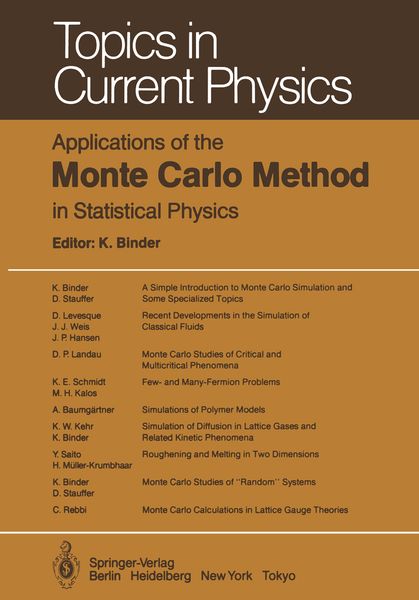
  • Produktbild: Applications of the Monte Carlo Method in Statistical Physics
  • Produktbild: Applications of the Monte Carlo Method in Statistical Physics
Band 36

Applications of the Monte Carlo Method in Statistical Physics

51,99 €

inkl. gesetzl. MwSt., Versandkostenfrei


Beschreibung

Produktdetails

Einband

Taschenbuch

Erscheinungsdatum

28.01.2012

Herausgeber

K. Binder

Verlag

Springer Berlin

Seitenzahl

311

Maße (L/B/H)

24,4/17/1,9 cm

Gewicht

575 g

Auflage

Softcover reprint of the original 1st ed. 1984

Sprache

Englisch

ISBN

978-3-642-96790-0

Beschreibung

Portrait

David P. Landau is the Distinguished Professor of Physics and Director of the Center for Simulational Physics at the University of Georgia.

Produktdetails

Einband

Taschenbuch

Erscheinungsdatum

28.01.2012

Herausgeber

K. Binder

Verlag

Springer Berlin

Seitenzahl

311

Maße (L/B/H)

24,4/17/1,9 cm

Gewicht

575 g

Auflage

Softcover reprint of the original 1st ed. 1984

Sprache

Englisch

ISBN

978-3-642-96790-0

Herstelleradresse

Springer-Verlag GmbH
Tiergartenstr. 17
69121 Heidelberg
DE

Email: ProductSafety@springernature.com

Kundinnen und Kunden meinen

0 Bewertungen

Informationen zu Bewertungen

Zur Abgabe einer Bewertung ist eine Anmeldung im Konto notwendig. Die Authentizität der Bewertungen wird von uns nicht überprüft. Wir behalten uns vor, Bewertungstexte, die unseren Richtlinien widersprechen, entsprechend zu kürzen oder zu löschen.

Die Bewertungen sind nach Format, Anzahl Sterne und Datum sortiert.

Verfassen Sie die erste Bewertung zu diesem Artikel

Helfen Sie anderen Kund*innen durch Ihre Meinung

Kundinnen und Kunden meinen

0 Bewertungen filtern

  • Produktbild: Applications of the Monte Carlo Method in Statistical Physics
  • Produktbild: Applications of the Monte Carlo Method in Statistical Physics
  • 1. A Simple Introduction to Monte Carlo Simulation and Some Specialized Topics.- 1.1 A First Guide to Monte Carlo Sampling.- 1.1.1 Random Numbers.- 1.1.2 An Example of “Simple Sampling”: The Percolation Problem.- 1.1.3 An Example of “Importance Sampling”: The Ising Model.- 1.1.4 An Example of Continuous Degrees of Freedom: The Heisenberg Model.- 1.1.5 A First Warning: Finite-Size Effects, Metastability, Slowing Down.- 1.2 Special Topics.- 1.2.1 What can be Learned from Distribution Functions; Finite-Size Scaling.- 1.2.2 Estimation of Free Energy and Entropy.- 1.2.3 Estimation of Intensive Thermodynamic Quantities.- 1.2.4 Interface Free Energy.- 1.2.5 Methods of Locating First-Order Phase Changes.- 1.2.6 Linear Response, Susceptibilities and Transport Coefficients.- 1.3 Conclusion.- Appendix. 1.A. Multispin Coding.- References.- Notes Added in Proof.- 2. Recent Developments in the Simulation of Classical Fluids.- 2.1 Some Recent Methodological Developments.- 2.1.1 Modified Metropolis Algorithms.- 2.1.2 Sampling in the Grand-Canonical Ensemble.- 2.1.3 Evaluation of the Chemical Potential.- 2.1.4 Variations on a Theme.- 2.2 Simple Monatomic Fluids.- 2.2.1 Hard-Core Systems in Two and Three Dimensions.- 2.2.2 Soft-Core and Lennard-Jones Systems in Two Dimensions.- 2.2.3 Rare-Gas Fluids in Three Dimensions.- 2.2.4 Binary Mixtures of Simple Fluids.- 2.3 Coulombic Systems.- 2.3.1 Boundary Conditions.- 2.3.2 The One-Component Plasma (OCP).- 2.3.3 Two-Dimensional Electron Layers.- 2.3.4 Liquid Metals.- 2.3.5 Primitive Model Electrolytes.- 2.3.6 Simple Models of Polyelectrolytes.- 2.3.7 Molten Salts and Superionic Conductors.- a) KCl.- b) KCN.- c) Alkali Chlorides.- d) Rb Halides.- e) Cs Halides.- f) Alkaline Earth Halides.- g) Molten Salt Mixtures.- h) Superionic Conductors.- 2.4 Molecular Liquids.- 2.4.1 Hard Nonspherical Particles.- a) Hard Spherocylinders.- b) Mixtures of Hard Spheres and Hard Spherocylinders.- c) Hard Diatomics.- 2.4.2 Two-Center Molecular Liquids.- 2.4.3 Simple Dipolar and Multipolar Liquids.- a) Dipolar Hard-Sphere Systems.- b) Two- and Three-Dimensional Stockmayer Fluids.- c) Systems of Polarizable Particles.- d) Steric Effects in Polar Fluids.- 2.4.4 Realistic Models of Molecular Liquids.- 2.4.5 Liquid Water.- 2.5 Solutions.- 2.5.1 Dilute Aqueous Solutions of Nonelectrolytes.- 2.5.2 Solvation of Ions.- 2.5.3 Solvation of Large Dipoles.- 2.5.4 Solvation of Biological Molecules.- 2.6 Surfaces and Interfaces.- 2.6.1 Liquid-Vapor Interface of Simple Fluids.- 2.6.2 Liquid-Vapor Interface of Molecular Fluids.- 2.6.3 Density Profiles of the One-Component Plasma and Liquid Metals.- 2.6.4 Liquid-Wall Interfaces.- 2.6.5 Liquid-Solid Coexistence.- 2.6.6 The Electrical Double Layer.- 2.7 Conclusion.- References.- 3. Monte Carlo Studies of Critical and Multicritical Phenomena.- 3.1 Two-Dimensional Lattice-Gas Ising Models.- 3.1.1 Adsorbed Monolayers.- 3.1.2 Ising Model Critical and Multicritical Behavior.- 3.1.3 Models with Incommensurate Phases.- 3.2 Surfaces and Interfaces.- 3.3 Three-Dimensional Binary-Alloy Ising Models.- 3.4 Potts Models.- 3.5 Continuous Spin Models.- 3.6 Dynamic Critical Behavior.- 3.7 Other Models.- 3.7.1 Miscellaneous Magnetic Models.- 3.7.2 Superconductors.- 3.7.3 Interacting Electric Multipoles.- 3.7.4 Liquid Crystals.- 3.8 Conclusion and Outlook.- References.- 4. Few- and Many-Fermion Problems.- 4.1 Review of the GFMC Method.- 4.2 The Short Time Approximation.- 4.3 The Fermion Problem and the Method of Transient Estimation.- 4.4 The Fixed Node Approximation.- 4.5 An Exact Solution for Few-Fermion Systems.- 4.6 Speculations and Conclusions.- References.- 5. Simulations of Polymer Models.- 5.1 Background.- 5.2 Variants of the Monte Carlo Sampling Techniques.- 5.3 Equilibrium Configurations.- 5.3.1 Asymptotic Properties of Single Chains in Good Solvents.- 5.3.2 Phase Transitions of Single Chains.- 5.3.3 Chain Morphology in Concentrated Solutions and in the Bulk.- 5.3.4 Phase Transitions at High Concentrations.- 5.4 Polymer Dynamics.- 5.4.1 Brownian Dynamics of a Single Chain.- 5.4.2 Entanglement Effects.- 5.5 Conclusions and Outlook.- References.- 6. Simulation of Diffusion in Lattice Gases and Related Kinetic Phenomena.- 6.1 General Aspects of Monte Carlo Approaches to Dynamic Phenomena.- 6.2 Diffusion in Lattice-Gas Systems in Equilibrium.- 6.2.1 Self-Diffusion in Noninteracting Two- and Three-Dimensional Lattice Gases.- 6.2.2 Anomalous Diffusion in One-Dimensional Lattices.- 6.2.3 Tracer Particles with Different Jump Rates and the Percolation Conduction Problem.- 6.2.4 Self-Diffusion and Collective Diffusion in Interacting Lattice Gases, Including Systems with Order-Disorder Phase Transitions.- 6.3 Diffusion and Domain Growth in Systems far from Equilibrium.- 6.3.1 Nucleation, Spinodal Decomposition, and Lifshitz-Slyozov Growth.- 6.3.2 Late-Stage Sealing Behavior.- 6.3.3 Diffusion of Domain Walls and Ordering Kinetics.- 6.3.4 Kinetics of Aggregation, Gelation and Related Phenomena.- 6.4 Conclusion.- References.- 7. Roughening and Melting in Two Dimensions.- 7.1 Introductory Remarks.- 7.2 Roughening Transition.- 7.2.1 Solid-on-Solid (SOS) Model.- 7.2.2 Dual Coulomb Gas (CG) Model.- 7.2.3 Step Free Energy and Crystal Morphology.- 7.3 Melting Transition.- 7.3.1 Theoretical Predictions.- 7.3.2 Computer Experiments on Atomistic Systems.- 7.3.3 Dislocation Vector System.- References.- 8. Monte Carlo Studies of “Random” Systems.- 8.1 General Introduction.- 8.2 Spin Glasses.- 8.2.1 Short-Range Edwards-Anderson Ising Spin Glasses.- 8.2.2 Short-Range Edwards-Anderson Heisenberg Spin Glasses.- 8.2.3 Site-Disorder Models.- 8.2.4 The Infinite-Range Model.- 8.2.5 One-Dimensional Models.- 8.3 Other Systems with Random Interactions.- 8.4 Percolation Theory.- 8.4.1 Cluster Numbers.- 8.4.2 Computational Techniques.- 8.4.3 Cluster Structure.- 8.4.4 Large-Cell Monte Carlo Renormalization.- 8.4.5 Other Aspects.- 8.5 Conclusion.- References.- Note Added in Proof.- 9. Monte Carlo Calculations in Lattice Gauge Theories.- 9.1 Lattice Gauge Theories: Fundamental Notions.- 9.2 General Monte Carlo Results for Lattice Gauge Systems.- 9.3 Monte Carlo Determination of Physical Observables.- References.- Additional References with Titles.